ENVIRONAIRIndoor Air Quality · Hong Kong Call us(852) 2416 6676

Home/Know the air you breathe every day

IAQ knowledge

Know the air you breathe every day

From pollution sources to filtration technology — three decades of site experience, distilled into practical guidance.

2–5× Indoor vs outdoor pollution0.3 μm HEPA test particle size4–15 /hr Recommended air changes
01

What is in indoor air

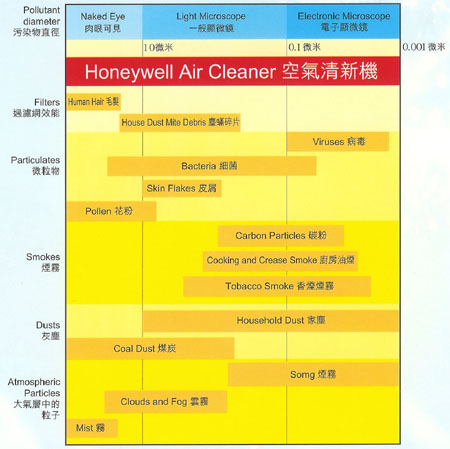
Home and office air holds hundreds of millions of particles — visible dust, and invisible allergens and microorganisms. They affect health, sleep and quality of living, and reduce the efficiency of air conditioning equipment.

Ordinary filters cannot provide relief; only the right filtration technology makes a measurable difference.
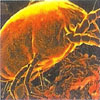
Dust mites & household dust
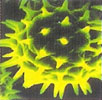
Pollen
Pollen
Bacteria & mould
Bacteria & mould
02

Three steps to better indoor air

01

Eliminate pollution sources

Use fewer products with volatile organic compounds — detergents, hair spray, adhesives and paints; choose low-VOC building materials, furniture and carpets.

02

Increase ventilation

Maintain good ventilation with sufficient fresh air supply; install exhaust where needed. Keep 23–26°C in summer, 20–24°C in winter, relative humidity 40–70%.

03

Install the right air cleaners

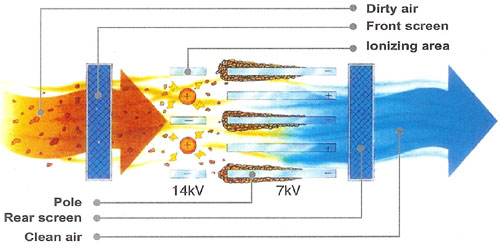
Match technology to the contaminant: HEPA for particles, activated carbon for odour and VOCs, electrostatic collection for grease mist and smoke.

03

Daily practice & selection guide

Daily practice

  • Avoid smoking indoors;
  • Use fewer consumer products containing VOCs;
  • Keep premises clean and dry;
  • Maintain good ventilation with sufficient fresh air;
  • Air out new furniture and dry-cleaned clothes before bringing them in;
  • Install air cleaners where needed.

Selecting an air cleaner

  1. Identify the contaminants first, then choose the suitable technology;
  2. Higher filtration efficiency is better (99.97% over 90%), and smaller filtered particles are better (0.01 micron over 0.3 micron);
  3. Airflow must match the space — ASHRAE suggests 4 to 15 air changes per hour;
  4. Choose HEPA or electrostatic units with generous filter / plate area, or they will need washing or replacement frequently;
  5. Note that ionisers may produce significant ozone and soil nearby walls and tables;
  6. Consider replacement cost, filter life and energy consumption — over the long term, electronic / electrostatic cleaners are more economical and environmental-friendly.
04

True HEPA filtration

HEPA — High Efficiency Particulate Air — describes a deep-bedded, randomly positioned fibrous media recognised as the most efficient way to remove sub-micron particulates: at least 99.97% at 0.3 micron.

Why choose Honeywell Enviracaire?
  • 99.97% efficiency at 0.3 micron; near 100% at 0.001 micron due to the diffusion effect;
  • Tested by Singapore's standards testing authority at >99.6% for bacteria, mould and yeast removal; also tested by NUH;
  • Classified by the US FDA as a Class II Medical Device (Reg #K872359);
  • Meets American Standard ES-1 for the Association for the Advancement of Medical Instrumentation (AAMI).
Multi-stage filtration: from pre-filter to HEPA
Honeywell filter types at a glance

Call us, we have the solution.

Call or email us to arrange a free initial consultation.

(852) 2416 6676 Contact us